Amsterdam transport pass comparison: GVB day pass, OV-chipkaart, Amsterdam Travel Card & I amsterdam City Card. Cost-per-ride breakdown for 1-3 day stays.
Amsterdam Transport Pass Comparison: Which Card Actually Saves You Money
Amsterdam offers five main transit card options, each suited to different trip lengths and budgets — and the one your hotel receptionist recommends isn't always the one that fits your itinerary. GVB day passes, the anonymous OV-chipkaart, the Amsterdam Travel Card, the I amsterdam City Card, and the Amsterdam & Region Travel Ticket all do roughly the same job — moving you around on trams, buses, metro, and sometimes ferries — but they price that job very differently depending on how many rides you take and how many days you stay.
This matters more than most guides admit. A couple staying two nights and taking six tram rides total will spend differently than a family of four riding to Zaanse Schans and back every day. I've broken this down by actual cost-per-ride below, because that's the number that tells you whether a pass is worth buying or whether you should just tap in and out with contactless payment instead. One thing to flag early: the I amsterdam City Card and the Amsterdam Pass bundle museum entry with transport, which changes the math entirely if you're planning to hit the Rijksmuseum, Van Gogh Museum, and Anne Frank House anyway.
Transport Passes at a Glance
Five products compete for your transit budget in Amsterdam, and they split into two philosophies: pay only for what you use, or pay a flat fee for unlimited rides within a window. Contactless bank cards and the anonymous OV-chipkaart fall into the first group. GVB day passes, the Amsterdam Travel Card, and the tourist city cards fall into the second.
The flat-fee passes win when you're moving around a lot — hopping tram to metro to bus repeatedly in a single day. The pay-as-you-go cards win when your trip is light on transit, maybe two or three rides a day between your hotel, a museum, and dinner. Don't assume unlimited is always better; it's only better past a certain ride threshold, which I'll calculate in the next section.
GVB Day Pass and Multi-Day Options
GVB, Amsterdam's municipal transport operator, sells unlimited-ride passes valid for 1, 2, 3, 4, 5, 6, or 7 consecutive days from first use, not calendar days. A 1-day pass typically runs in the €9-10 range; each additional day adds roughly €4-5, so a 3-day pass lands somewhere around €19-21. These cover trams, buses, and the metro within Amsterdam city limits — they do not cover regional trains or buses to places like Zaanse Schans or Volendam. You buy them at GVB ticketing machines at Amsterdam Central Station, from the conductor on trams (card payment only), via the GVB app, or at GVB service points. The pass activates the moment you first tap in, which matters — buy it the night before if you're starting an early morning tour, so day one doesn't get wasted on a half-used evening.
OV-Chipkaart Anonymous Card
The anonymous OV-chipkaart is the Dutch pay-as-you-go system, similar in concept to London's Oyster card or Berlin's Fahrkarte options, but nationwide. You buy the physical card for around €7.50-€10 (non-refundable card fee), load credit onto it, then tap in and tap out for every single journey — forgetting to tap out triggers a maximum fare deduction, which is the single most common tourist mistake with this system. Fares are distance-based, typically starting around €1 base plus a per-kilometer charge, so a short tram hop might cost €1.20-€1.50 while a longer cross-city ride costs more. Honestly, for short stays the anonymous OV-chipkaart's upfront card cost eats into its savings unless you're taking at least 4-5 rides — and you can now often tap a contactless bank card or phone directly without buying the physical card at all, which is simpler for a 2-3 day visit.
Head-to-Head: Cost, Validity, Coverage
Validity periods differ in ways that trip people up. GVB passes run on a 24-hour rolling clock from activation, not midnight-to-midnight, which actually benefits travelers who start sightseeing in the afternoon. The I amsterdam City Card and Amsterdam Pass work the same way — a 24, 48, 72, or 96-hour pass bought at 3pm is valid until 3pm however many days later. The Amsterdam & Region Travel Ticket is different again: it's a fixed-day pass that also covers regional buses and trains, useful if Zaanse Schans, Muiderslot, or the Hague are on your itinerary.
Coverage area is the other major differentiator, and it's where people lose money without realizing. A straight GVB pass stops at the city boundary. If you're heading to the Hague, Utrecht, or Rotterdam by train, none of these city-specific passes cover that — you need a separate NS train ticket or OV-chipkaart credit for the intercity leg.
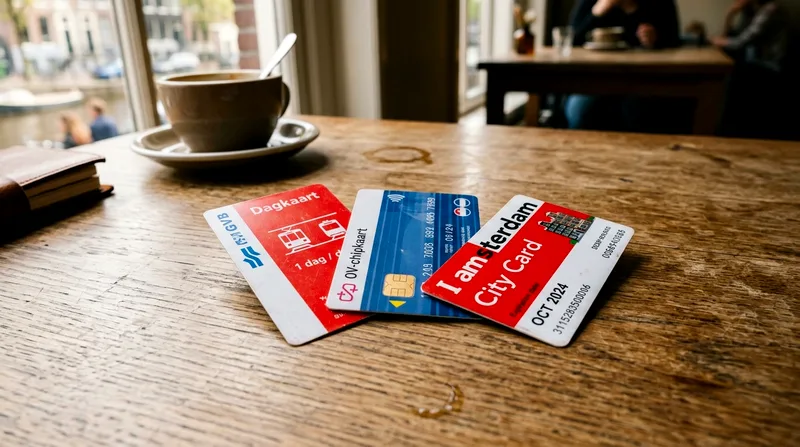
GVB day passes offer the simplest flat-fee transit coverage, while the I amsterdam City Card and Amsterdam Pass add museum entry at a higher price point.
Amsterdam transport pass comparison: cost, validity, and coverage by card type
| Pass | Typical Cost | Validity | Coverage | Best For |
|---|---|---|---|---|
| GVB Day Pass | €9-21 (1-7 days) | 24hr rolling, 1-7 days | Amsterdam city trams/bus/metro | Short city-only stays, frequent riders |
| OV-chipkaart (anonymous) | €7.50-10 card + pay-per-ride | No expiry, tap in/out | Nationwide, distance-based | Light transit use, flexible trips |
| Amsterdam Travel Card | Mid-range, scales by days | 24hr rolling, multi-day options | City + some regional trains/buses | Day trips beyond city limits |
| I amsterdam City Card | Higher, bundles attractions | 24-96hr rolling | City transit + 70+ museums | Museum-heavy itineraries |
| Amsterdam & Region Travel Ticket | Mid-to-high, fixed-day | Fixed calendar days | City + wider regional network | Zaanse Schans, Haarlem day trips |
Prices are approximate and change periodically; check current rates on the GVB or I amsterdam website before booking.
Time and Effort to Purchase
GVB passes are the fastest to get — machines at Central Station take under two minutes, cards only, no cash. The I amsterdam City Card requires a visit to the I amsterdam visitor centre (there's one near Central Station and one at Schiphol Airport) or online pre-booking with physical pickup, which adds 10-15 minutes of queuing during peak season, especially July and August. The anonymous OV-chipkaart is sold at GVB machines, Schiphol Airport kiosks, and some supermarkets (AH, Primera), so availability is wide but loading credit requires a Dutch debit card or cash at machines — some international credit cards get rejected, which is an underreported annoyance.
Geographic Reach and Zone Limits
Think of it as three concentric circles. GVB day passes cover city-only — trams, buses, metro within Amsterdam. The Amsterdam Travel Card and Amsterdam & Region Travel Ticket extend further, pulling in regional operators and some NS regional trains. The I amsterdam City Card and Amsterdam Pass match GVB's city-only transit coverage but add free or discounted entry to 70+ museums and attractions, which is the real value driver, not the transit piece. If your trip is Amsterdam-only, city-tier passes are fine. If you're day-tripping to Haarlem, Volendam, or further, check whether your pass actually reaches there before assuming it does.
Cost-Per-Ride Breakdown by Stay Length
This is the calculation that actually decides which card wins, and it depends almost entirely on how many rides per day you're realistically taking — not on trip length alone.
1-Day Visitor Scenarios
If you're taking 2 rides in a single day — say, airport-to-hotel isn't included, but a trip to the Rijksmuseum and back — pay-as-you-go OV-chipkaart tapping (around €1.20-€1.50 per short ride) costs roughly €2.40-€3.00 total, far cheaper than a €9-10 GVB day pass. But if you're doing 4+ rides (museum, canal area, Jordaan, back to hotel, out to dinner), the GVB day pass's flat €9-10 starts beating pay-per-ride, which would run €4.80-€6.00 for four rides and climb past the pass price with a fifth or sixth ride. The breakeven point is almost always around 5-6 rides per day.
2-3 Day Trip Calculations
Over 2-3 days, a GVB 2-day pass (around €14-15) or 3-day pass (around €19-21) usually beats loading an OV-chipkaart if you're averaging 4+ rides daily — common for families splitting time between Vondelpark, the Van Gogh Museum, and the Anne Frank House. Work it out: 3 days at 5 rides a day is 15 rides; at €1.30 average per ride, that's roughly €19.50 on pay-as-you-go versus about €20 for the GVB 3-day pass — basically a wash, so convenience tips it toward GVB (no tap-out anxiety, no maximum-fare penalties). If you're a couple doing only 2-3 rides a day, stick with OV-chipkaart or contactless tap-in — you'll likely spend €8-12 total over 3 days versus €20 on a pass you're not using enough.
Who Should Choose Which Card
There's no single best transport pass for Amsterdam — there's a best pass for your specific ride count, trip length, and whether museums factor in. Here's the honest breakdown by traveler type, including who I think is wasting money on the wrong pass.
Day Trippers and Short Stays
Solo travelers or couples on a 24-48 hour layover-style visit, hitting 2-3 attractions, should skip the pass entirely and tap a contactless bank card or phone directly on GVB trams and buses — no card purchase, no activation, no risk of overpaying for unused days. If you're doing a packed single day with 5+ stops (common for first-timers trying to see Dam Square, the Jordaan, and the museum quarter in one go), the GVB 24-hour pass pays for itself. Weed smokers heading between coffeeshops in De Pijp and the Red Light District on foot mostly won't need transit at all — Amsterdam's center is compact enough to walk most of it in under 40 minutes end to end.
Multi-Day Tourists and Locals
Families staying 3+ days with kids who tire of walking, or senior travelers who want to minimize standing and walking distance, benefit most from a GVB multi-day pass or the Amsterdam Travel Card if a regional day trip (Zaanse Schans, Haarlem) is planned. If museum visits are the real priority — Rijksmuseum, Van Gogh, Anne Frank House, Stedelijk — run the math on the I amsterdam City Card or Amsterdam Pass; the combined attraction value often exceeds what you'd pay for separate tickets plus a transit pass, though only if you'll genuinely visit 3+ paid attractions. Residents or those staying over a week should get a personal OV-chipkaart instead, since it's cheaper long-term and avoids the city-card markup entirely — comparable to how a Berlin Welcome Card only makes sense for short visits, not month-long stays.
How to Buy and Activate Your Pass
GVB passes and anonymous OV-chipkaarts are both sold at GVB ticketing machines throughout Amsterdam Central Station and other major stops — machines accept debit/credit cards but frequently reject certain international credit cards, so have a backup payment method. The GVB app lets you buy digital day passes without touching a machine at all, and I'd recommend this route if your phone has reasonable battery life, since paper tickets are increasingly being phased out on trams.
The I amsterdam City Card and Amsterdam Pass require either online pre-purchase with pickup at the I amsterdam visitor centre near Central Station or at Schiphol Airport, or a physical purchase on-site — expect a short queue in summer. Activation for all multi-day passes happens on first tap, not at purchase, so buying a day or two in advance costs you nothing as long as you don't tap in early. One genuine annoyance: lost or damaged City Cards generally aren't refunded, so keep it somewhere secure, not in a back pocket. Compare current prices and card options directly on the GVB and I amsterdam websites before you commit, since fare structures get adjusted periodically.
Frequently asked questions
What is the best travel pass for Amsterdam?
It depends on ride frequency. For 4+ rides a day over 2-3 days, a GVB multi-day pass offers the best balance of cost and convenience. For lighter use (2-3 rides daily), tapping a contactless card or anonymous OV-chipkaart is cheaper. If museums are a priority, the I amsterdam City Card often wins on combined value.
What is the cheapest way to use public transportation in Amsterdam?
Tapping a contactless bank card or phone directly on trams and buses, paying per ride (roughly €1.20-€1.50 for short hops), is cheapest for low-frequency use. No card purchase, no deposit, and you only pay for rides taken — ideal if you're mostly walking and using transit occasionally.
Is the Amsterdam Travel Card worth it?
Only if your itinerary includes regional trips beyond city limits — Haarlem, Zaanse Schans, or similar. For Amsterdam-only sightseeing, a standard GVB day pass covers the same city transit at a lower price, since you're not paying for regional reach you won't use.
What is the difference between GVB and OV-chipkaart?
GVB is Amsterdam's transit operator selling flat-fee unlimited day passes for city trams, buses, and metro. The OV-chipkaart is the nationwide pay-as-you-go system usable on GVB and beyond — you tap in and out, and fares scale by distance. GVB passes suit heavy daily use; OV-chipkaart suits occasional or longer-distance travel.
Does the Amsterdam Travel Card include museums?
No. The Amsterdam Travel Card covers transit only — city transport plus some regional trains and buses. For bundled museum access, you need the I amsterdam City Card or Amsterdam Pass, which include transit plus free or discounted entry to 70+ attractions.