Compare Amsterdam to Bruges day trips: guided coach tours vs train DIY, travel time, costs, and what you can realistically see in one day.
Who should book an Amsterdam to Bruges day trip
Bruges is one of Europe's best-preserved medieval towns — cobbled squares, canals, Gothic towers, and a skyline that hasn't changed much since the 15th century. The catch is geography. Bruges sits in Belgium, about 230 km from Amsterdam, and there's no fast direct rail link, so the trip eats a serious chunk of your day before you've seen a single gable.
An Amsterdam to Bruges day trip makes sense for travelers who are short on time but long on itinerary ambition — the kind of person squeezing Amsterdam, Brussels, and maybe Bruges into one European trip. If you're the type who'd rather see five cities in broad strokes than two cities in depth, this trip fits. It also suits travelers already planning to pass through Belgium, since Bruges pairs logically with Brussels or Ghent on the way.
It doesn't suit everyone equally well, though. If you're traveling with young kids, a 6-plus hour round trip of sitting — on a coach or train, then walking for hours — is a hard sell. Senior travelers with mobility concerns should also weigh the amount of standing and cobblestone walking involved; Bruges' old town is almost entirely stone streets, uneven in places, with few benches.
Best suited for time-limited travelers
If you have one week in the Netherlands and want a taste of Belgium without restructuring your whole trip, a day trip is the pragmatic choice. You get the postcard version of Bruges — canal views, the Markt square, a waffle, maybe a canal boat ride — without booking another hotel or packing a bag again. World travelers doing a multi-country European loop often use Amsterdam as a base and treat Bruges as a side excursion, the same way some do Bruges from Brussels in half a day. It's a reasonable trade: you sacrifice depth for convenience.
When to skip it for an overnight stay
If you genuinely care about atmosphere — the quiet canals at dusk, dinner without day-trippers crowding the Markt — skip the day trip and stay one night in Bruges instead. Rick Steves has long argued Bruges rewards an overnight stay precisely because the town empties out by early evening, once the coach tours from Amsterdam, Brussels, and Paris head home. Couples and photography-minded travelers get far more out of a sunset and early-morning visit than a packed midday sprint. If that's you, consider Bruges as a one- or two-night detour rather than a tour booking.
Guided coach tours vs independent train travel
There are really two ways to do this trip: book a guided coach tour from Amsterdam, or go independently by train. Both get you to Bruges; they differ sharply in cost, flexibility, and how much of the day is actually yours.
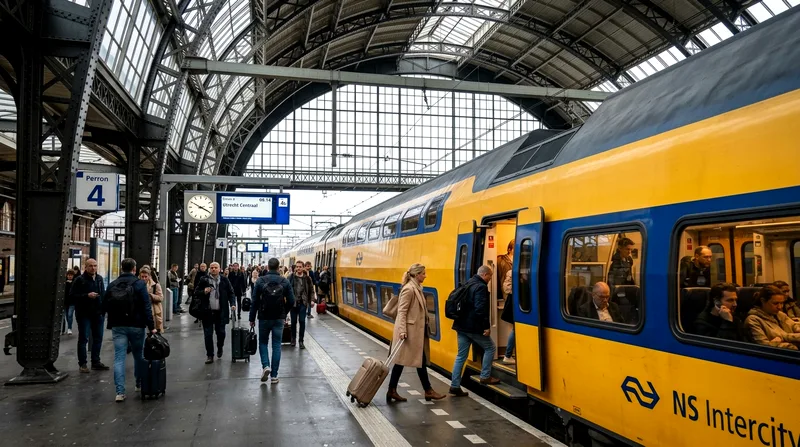
Coach tours, sold through platforms like Viator and GetYourGuide, bundle round-trip transport with a guide and sometimes a walking tour or boat ride once you arrive. They're typically long days — many run close to 14 hours door to door, departing Amsterdam early and returning late, because the drive itself takes around 3 to 3.5 hours each way. The DIY train route is faster on paper but more complicated: there's no direct train, so you connect via Brussels or Antwerp, with total journey time landing around 4 to 4.5 hours each way once you include the connection and station transfers.
A guided coach tour costs more but removes the logistics; the train is cheaper and faster but requires a connection and no guidance.
Amsterdam to Bruges day trip: coach tour vs train compared
| Option | One-way travel time | Typical cost range | Free time in Bruges | Best for |
|---|---|---|---|---|
| Guided coach tour | approx. 3-3.5 hours | Mid-range, higher than train | approx. 4-5 hours | First-timers, no-hassle travelers |
| Train via Brussels | approx. 4-4.5 hours (with connection) | Lower than coach tours | Fully flexible | Independent, budget-conscious travelers |
| Private driver/small group | approx. 3 hours | Highest of the three | Flexible, negotiable | Families, small groups wanting comfort |
Typical figures based on standard routes and tour lengths; actual travel times and prices vary by season and traffic, so check current schedules before booking.
Coach tour advantages and drawbacks
A coach tour from Amsterdam removes the logistics headache — no transfers, no ticket-buying in a second language, and a guide who explains what you're looking at. For first-time visitors or anyone nervous about navigating Belgian rail, that's worth something. The drawback is time and control: you're on the bus's schedule, free time in Bruges is usually capped at 4 to 5 hours, and you're often boxed into a set lunch spot or souvenir stop. Group sizes vary widely — some tours run with 20 to 50 people on a full coach, others cap at smaller minibus groups of around 8. Smaller groups cost more but move faster and feel less like a school trip.
DIY train option: flexibility and savings
Taking the train from Amsterdam to Bruges independently costs less than a guided tour in most cases and gives you full control over timing — leave whenever you want, stay as late as you like, skip the souvenir shop entirely. The downside is real effort: booking separate tickets (often through NS International or Belgian rail), navigating a change at Brussels-Midi, and having zero guidance once you arrive. For a confident independent traveler or anyone who's done Berlin, Paris, or Cologne by rail before, this is the better-value option. For a nervous first-timer, it adds stress to an already long day.
What you can realistically see in one day
Here's the blunt math: if you leave Amsterdam around 7:30-8:00am and travel 3 to 4 hours each way, you'll have roughly 4 to 5 hours of actual time in Bruges, minus lunch. That's enough to see the historic core properly but not enough to explore museums in depth or wander aimlessly, which is half of what makes Bruges appealing in the first place.
Worth seeing sights and realistic timing
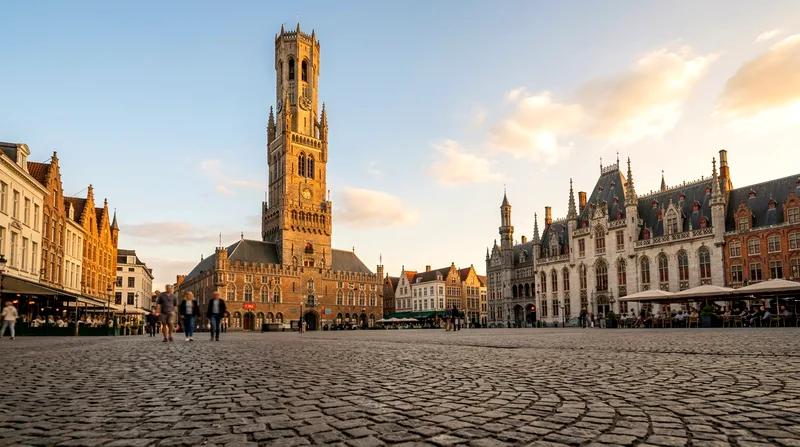
Plan around three anchors: the Markt square with its Belfry tower (climbing the 366 steps takes about 30-40 minutes round trip and costs a modest entry fee), the Burg square next door with the Basilica of the Holy Blood, and a walk along the Dijver canal toward the Begijnhof. Budget about 2.5 to 3 hours for this core loop at an unhurried pace, including photo stops. Fodor's and TripAdvisor reviewers consistently flag the Markt-to-Begijnhof walk as the single best use of limited time in Bruges — it's compact, about 1.5 km, and covers most of what people come to see. Skip the full Groeninge Museum visit unless you have a second day; one proper collection alone needs 1.5-2 hours to do justice.
Optional add-ons: boat tours and beer tastings
Many day trips include or offer as an add-on a short canal boat ride, usually 30 minutes, which is genuinely worth the time since it shows you facades and bridges you can't see from the street. Beer tastings are the other common extra — Belgium's brewing tradition is real, and a guided tasting of 3-4 regional beers takes about 45 minutes to an hour. Both are reasonable uses of limited free time; a chocolate-making demo, by contrast, often runs long for what you get and can eat into time better spent just walking the canals.
Key booking factors: duration, inclusions, group size
Not all "Bruges day trip" listings are equal, even when they look similar on Viator or GetYourGuide. Read the fine print on three things before you book: total duration, what's actually included, and group size.
Duration matters because some tours quietly combine Bruges with Ghent or Brussels, which sounds efficient but actually shrinks your Bruges time to 2.5-3 hours — barely enough for the Markt and a quick walk. If Bruges is the priority, choose a listing dedicated to Bruges alone, not a multi-city combo.
Free time allocation and group size impact
Check how the listing splits guided time versus free time. Some tours run a 60-90 minute walking tour then release you for 2-3 hours unsupervised; others guide you most of the day with little room to wander. If you're an independent-minded traveler, prioritize listings advertising more free time. Group size affects pace directly — a 50-person coach group means slow bathroom breaks and crowded photo spots at the Belfry; a group capped around 15-20 moves noticeably faster through narrow medieval streets.
Cancellation policies and what's included
Most reputable listings offer free cancellation up to 24 hours before departure — don't book anything that doesn't, given how weather-dependent a Belgium trip can be. Check whether lunch, the boat ride, and the Belfry entry fee are included or extra; a cheap-looking tour price sometimes excludes the Belfry climb and boat ride entirely, which can add a meaningful amount once you're there. Compare the full inclusions list across two or three listings on Viator or GetYourGuide before assuming the lowest price is the best value.
Best time to book and travel
Spring (April-May) and early autumn (September) are the sweet spot for an Amsterdam to Bruges day trip — mild weather, manageable crowds, and canal boats running full schedules. Midsummer (July-August) means more tour departures and longer boat-tour hours, but also the thickest crowds around the Markt and Belfry, with queues for the tower climb sometimes running 30-45 minutes. Winter trims your usable daylight significantly; with sunset before 5pm, a day trip in December or January leaves you walking a dim, half-empty old town by the time you'd normally still be sightseeing.
Booking timing matters less for trains — you can often buy those a few days ahead — but guided coach tours, especially smaller-group options, can sell out a week or more in advance during peak season (June through August) and around Christmas markets in late November and December. If your travel dates are fixed, book the coach option 1-2 weeks out; for trains, a few days' notice is usually fine, though booking earlier can lock in cheaper fares on the Belgian rail legs. Always compare current prices and reviews before you book, since availability and cost shift with season and demand.
Frequently asked questions
Is a day trip to Bruges from Amsterdam worth it?
It depends on what you want. If you just want to see Bruges' core sights once and check the box, yes — it's a long but manageable day. If you want to experience the town's quieter, slower character, it's not worth it; that requires an overnight stay, since most day-trippers leave by late afternoon.
How long is the journey from Amsterdam to Bruges?
By coach, expect roughly 3 to 3.5 hours each way via highway. By train, it's usually 4 to 4.5 hours each way because there's no direct line — you'll connect through Brussels or Antwerp. Round trip, you're looking at 6 to 9 hours of travel depending on the method.
Should I book a guided tour or go independently?
Book a guided coach tour if you want zero logistics hassle and don't mind paying more for it. Go independently by train if you're comfortable navigating a connection in Brussels and want to save money and control your own schedule — it usually works out cheaper than a tour.
What can you realistically see in Bruges in one day?
With 4 to 5 hours of free time, you can comfortably cover the Markt square, Belfry tower, Burg square, and a canal-side walk to the Begijnhof, plus a short boat ride. A full museum visit or deep exploration beyond the historic core isn't realistic on a single day trip.
How much does an Amsterdam to Bruges day trip cost?
Guided coach tours generally cost more than independent train travel because transport, a guide, and sometimes lunch or a boat ride are bundled in. Train tickets alone are the cheapest option but require booking separate legs. Always check current prices on Viator, GetYourGuide, or NS International before booking, since fares shift by season and demand.